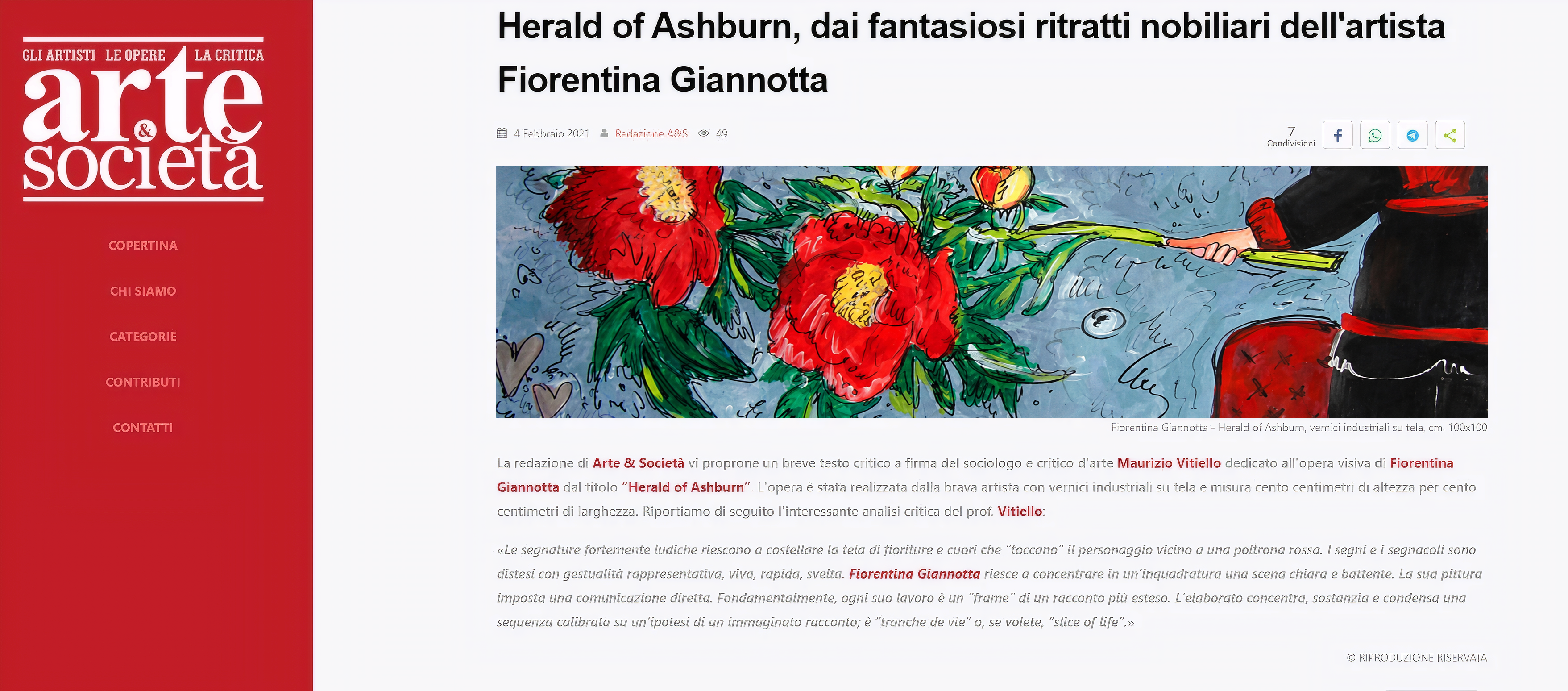
Nell’atelier di Fiorentina aleggia un odore acre da officina meccanica. Barattoli di acrilici e tele di grandi dimensioni – alcune imponenti – danno la percezione del lavoro materiale – materico, tattile direi – da cui l’artista distilla le sue atmosfere. C’è un mondo, dentro queste tele accatastate, un mondo di volti, di storie, di Storia i cui personaggi si distaccano dal proprio tempo per immergersi negli sfondi giocosi, surreali e floreali, in cui l’artista li fa rivivere. Ci sono santi, conti, infante di Spagna, vicerè. E poi gente comune, trasfigurata dalla vestizione settecentesca e dagli sfondi onirici fatti di cuori di croci di slogan da cartellone pubblicitario, di fiori giganteschi e vorticanti.
Molteplici sono gli echi ed i riferimenti della pittura di Giannotta, come la sua biografia composita e frammentata. L’infanzia newyorkese, di cui conserva le radici nelle frequenti trasferte e nel gusto ironico dissacratorio, gli studi di architettura a Firenze che ampliano e strutturano la sua formazione artistica, l’attività professionale a Cosenza e nel sud Italia che segna un ritorno alla cultura ed ai colori delle origini.
Infine, l’ingresso nel terzo millennio, con la definizione dei topoi della sua pittura: la riscoperta di una dimensione sacrale, con le opere conservate nel museo diocesano di Lecce e con la realizzazione della pala d’altare vincitrice del concorso per la chiesa di Giorgilorio (LE); e, soprattutto, con la focalizzazione sul tema del ritratto.
Debitori della gloriosa tradizione rinascimentale e fiamminga, i personaggi di Fiorentina si stagliano impettiti nelle loro mise aristocratiche; a differenza però del nero assoluto degli sfondi fiamminghi e dei paesaggi sfumati e in dissolvenza della tradizione toscana, le sagome dei suoi ritratti vivono in totale sinergia con i decori di fondo.
Lo sfondo inviluppa, dà voce e racconto, a volte sovrasta per dimensioni e cromatismi le figure dipinte. C’è una sorta di horror vacui, come nella pittura immaginifica di Klimt e nella più lontana tradizione gotica e barocca, che porta la pittrice a riempire gli spazi senza gerarchia di piani o di scala. Il risultato è un delirio onirico di matrice surrealista, da cui solo lo sguardo dei personaggi si distacca, a volte distratto, a volte diretto, come a stabilire un difficile contatto con l’osservatore. Emerge, in questa raffigurazione dissonante e sospesa, lo straniamento dell’uomo contemporaneo, la sua solitudine lontana dalla nettezza di contorni e piani visivi dell’uomo rinascimentale, il senso di finzione che aleggia, dalle trine e merletti della vestizione alle acconciature acrobatiche e anacronistiche.
Nel colore, preso in prestito dall’industria automobilistica, nella sua stesura piatta e nei cromatismi saturi e dissonanti, l’artista riscopre i suoi legami con il luogo di nascita, quella New York da cui la pop art proprio nel ’64, anno di nascita della pittrice, inizia a sconfinare dagli USA alla Biennale di Venezia. Ad una matrice pop appartiene la ricorrenza iconica degli elementi decorativi di fondo, il loro dilagare come protagonisti del quadro, in un mondo dominato dagli oggetti, dai sentimenti esternati o gridati negli slogan.
“I love my followers”, “all you need is art”, “mi piaci così come sei”, sono altrettanti hashtag, che emergono decisi dalle immagini di Fiorentina, a raccontarci un mondo dominato dai social, in cui un ritratto altro non è che una foto profilo, un messaggio in bottiglia lanciato a raccontare quello che siamo – o quello che non siamo – nelle evanescenti maglie della rete.
A pungent smell wafts through Fiorentina’s atelier, as in a mechanical workshop. Cans of acrylics and large canvases – some huge – give the perception of material work – one would say of tactile matter itself – from which the artist distils her atmospheres. There is a world inside these canvases piling up on one another, a world made of faces, stories, of History itself whose characters sublimate from their time to find themselves immersed in playful, surreal and floral backgrounds, in which the artist brings them back to life. There are saints, counts, Spanish infantes, viceroys. And then the common people, cloaked in eighteenth-century attire and steeped in dreamlike backgrounds made of hearts, crosses, catchphrases from billboards, and then massive and swirling flowers.
Many echoes and references perspire from Giannotta’s painting, such as her multi-faceted and fragmented biography. Her childhood in New York, the roots of which are apparent in her frequent travels and irreverent, ironic style; the studies in architecture in Florence which provided structure to her artistic training and expanded it; her professional activity in Cosenza and the South of Italy, marking a return to the culture and colours of her origins.
Finally, the entry into the third millennium, with the definition of the topoi of her painting: the rediscovery of a sacred dimension, with the works kept in the diocesan museum of Lecce and with the creation of the altarpiece which won of the competition for the church of Giorgilorio (LE); and, above all, by focussing on the medium of the portrait.
Channeling the glorious Renaissance and Flemish tradition, Fiorentina’s characters stand out stiffly in their aristocratic outfits; however, unlike the absolute black of the Flemish backgrounds and the blurred and fading landscapes of the Tuscan tradition, the outlines of her portraits exist in total synergy with the background decorations.
The background envelopes, gives voice and narrates, sometimes overwhelming the painted figures in size and chromatic richness. There is a sort of horror vacui, same as in Klimt’s imaginative painting and further back in the Gothic and Baroque traditions, prompting the artist to fill the spaces without any layer or size hierarchy. The result is a dreamlike hallucination of the surrealist mold, from which only the characters’ gaze stands out, sometimes casually, sometimes directly, as if attempting to establish a difficult contact with the observer. In this dissonant and suspended representation there emerges the estrangement of the contemporary human condition, with its solitude, away from the sharply delineated contours and visual planes of the Renaissance man, the sense of affectation that hovers, from the outfits’ frills and lace to the acrobatic and anachronistic hairstyles.
Colour is borrowed from the automotive industry, with its flat texture and saturated and dissonant palette; thus the artist rediscovers her birthplace connections, that New York from which in 1964 – the artist’s birthyear – Pop Art begins to radiate out of the US, towards the Venice Biennale. The Pop milieu also perspires in the iconic recurrence of the underlying decorative elements, their taking over as the true protagonists in a painting, in a world dominated by objects, by feelings expressed or shouted in slogans.
“I love my followers”, “All you need is art”, “mi piaci così come sei”
(“I like you as you are”), are as many hashtags, which come out strongly in Fiorentina’s images to tell us about a world dominated by social media, in which a portrait is but a profile picture, a message in a bottle sent out to express what we are – or what we are not – in the ephemeral mesh of the network.